Office jewelry by scale: what reads professional from law firms to studios

The old office jewelry rules — one ring per hand, no visible chains, studs only — were written for a workplace where dress codes were enforced from the top down. That workplace is mostly gone. What has not gone anywhere is the underlying mechanic: jewelry is read at conversational distance, in motion, during the first minutes of a meeting, and the variable that decides whether it reads professional is not how many pieces you wear but how big they are and how much they move.
Scale is the variable, not formality
A signet ring and a two-carat ring are the same category on paper and different categories in a meeting. The difference is scale — how much visual area the piece claims and how far away it registers. Offices that would have banned jewelry outright two decades ago now tolerate almost anything at small scale, and the offices that still enforce restraint are really enforcing scale plus one other variable: motion.
Movement is the quiet second rule. Earrings that swing when you turn your head, bracelets that clink on the desk, chains that slide off the collar when you lean forward — these register constantly, throughout the meeting, in a way that a still piece never does. A large still piece reads as personal style; a small moving piece reads as distraction. Scale governs how much attention a piece earns once; motion governs how many times it earns it.
The client-facing baseline
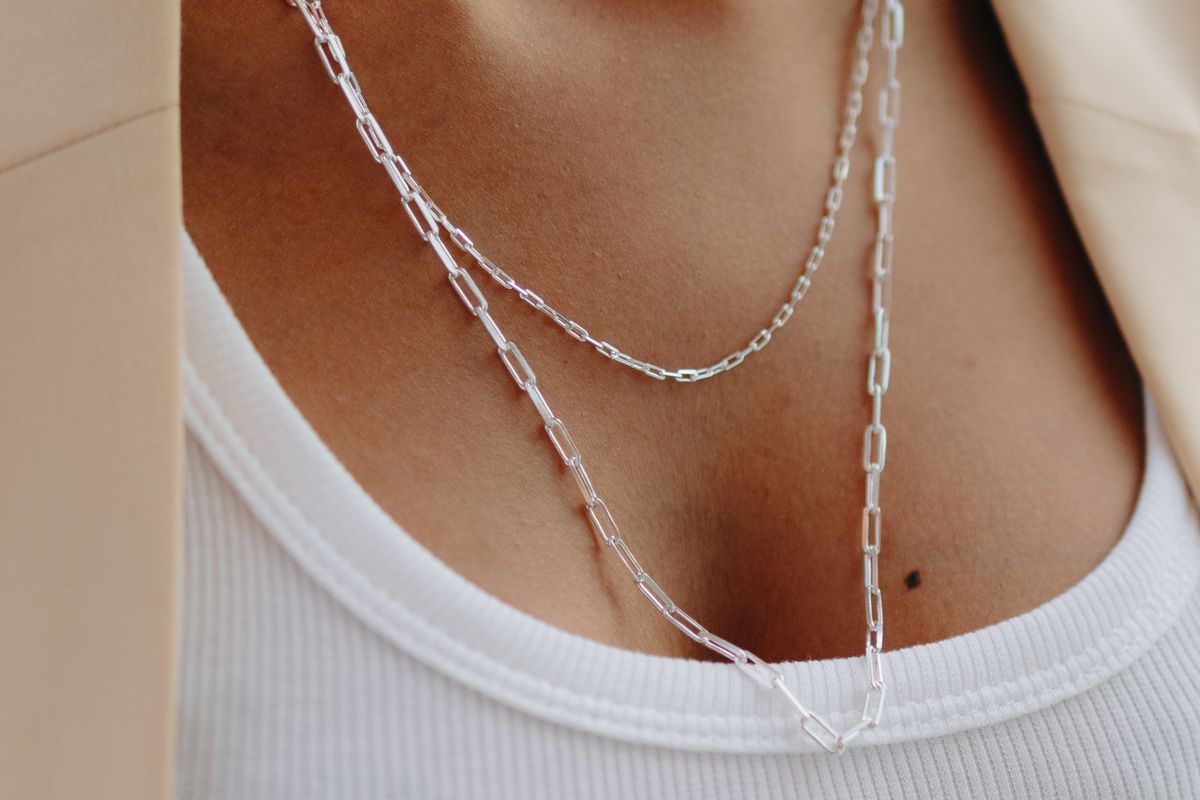
The baseline that works anywhere a stranger’s first impression matters: small studs or a short drop earring, one or two rings per hand, and a 16 to 18 inch chain worn at the collar. It is a low-ceilinged look by design — nothing in it requires an explanation, catches light during a handshake, or needs adjusting after putting on a coat. Everything more expressive you own can be added on top of this baseline on days you know the room; nothing expressive can be safely subtracted from a louder starting point once the meeting starts.
The baseline also solves the practical problems client-facing work creates. Jewelry that extends past the earlobe or spans the knuckle catches on scarves, coat linings, and headset arms; a stack of bangles makes noise on every conference table. The quiet baseline never fights with the equipment of a working day.
Finance, law, and the caution premium
Client-facing conservative firms still carry an implicit premium on restraint, and the reason is attribution: in these rooms, an unusual piece gets read as a signal whether or not it is meant as one. The practical translation is the baseline at full conservatism — studs, a band, the chain — with the watch as the one piece of expressive real estate that is always safe. A watch reads as equipment, not decoration, in exactly the rooms where everything else is scrutinized.
The useful reframe for these workplaces is that restraint is not subtraction but replacement: the expressive budget goes into materials rather than size. A small earring in a rich gold or a ring with a notable stone cut small delivers the statement at conversation scale.
What a signet says in a conservative room
Signets occupy a peculiar position in conservative offices: historically masculine, now worn by everyone, and read as heritage rather than flash. A modestly sized signet on the pinky or ring finger is among the few large-face rings that passes scrutiny in these rooms, because the tradition it references is exactly the tradition these institutions admire. The face size is what keeps it inside the line — signets scaled toward the dramatic tip back into costume.
Tech, media, and creative studios
The offices where the baseline loosens completely. Statement earrings, layered chains, stacked rings, ear cuffs, and visible personalization all read normally, because in these workplaces the jewelry is doing résumé work — it signals that you understand the room’s aesthetic, which in a design-adjacent job is part of the job. The only failure modes that persist are motion and maintenance: pieces that clink on desks during a focused workday wear out their welcome in any office, expressive or not.
The practical trap in permissive offices is the opposite of the conservative trap: calibrating down out of habit. The baseline still works as a floor, but wearing it unchanged in a studio where everyone else treats jewelry as self-expression is its own kind of misread.
Healthcare, teaching, and hands-on work
The most concrete limits of any workplace, because most of them are practical rather than stylistic. Glove work tends to rule out high-profile stones and anything with catch points — a tall stone or an engraved band scratches gloves and hides residue — so smooth, low-profile bands are the functional answer, and many hands-on workers leave rings off entirely and wear them on a chain instead. Earrings collapse to studs, and anything that dangles past the lobe is a hazard around machinery, children, or patients regardless of what any dress code says.
The chain-under-scrubs compromise
The standard workaround in scrubs-and-gloves environments: the jewelry moves to the chain. Rings and bracelets that cannot be worn on the hands go on a short chain worn under the top layer, which keeps them close, out of the work zone, and off the hands. It is not a style solution and it is not meant to be — it is the version of the capsule that survives the job.
Interviews and the first two weeks
The interview version of the baseline is one notch below it: small studs, at most one ring per hand, nothing on the wrist that moves or clinks. The reasoning is simple — in an interview, the jewelry should survive being completely unremarkable, and every interviewer who notices it is a small fraction of attention not spent on the answers.
The first two weeks on the job are the observation window. Match the baseline at first, watch what the people one level above you wear, and calibrate toward that rather than toward the most permissive person in the room. The people above you, not the dress code document, are the real evidence of where the ceiling is.
The one upgrade that changes an office look
When the baseline needs to look finished rather than minimal, the highest-leverage change is a watch — it fills the wrist zone that a bare arm leaves empty, reads as equipment in every office type, and does more for a sleeve-and-cuff combination than any bracelet. The second-leverage change is swapping the studs for a short drop on days with a meeting that matters. Both changes stay inside the scale line, which is why they work everywhere the baseline does. For the watch zone specifically, the watch desk covers the constructions that survive daily wear, and the broader picture of how jewelry reads across contexts lives in the styling desk; the pieces that round out a working week belong to the wider accessories range.
Frequently asked
What is the safest jewelry for a conservative office?
Small studs or short drops, one or two rings per hand, and a 16 to 18 inch chain. That baseline never reads wrong in a client-facing setting, and everything more expressive can layer on top once you know the room.
Are statement earrings acceptable at work?
In most creative, media, and tech environments, yes — statement earrings have largely replaced the necklace as the expressive piece at work. In client-facing firms they read as event jewelry, so the short drop is the safer call.
How much jewelry should you wear to a job interview?
One notch below the office baseline: small studs, at most one ring per hand, no bracelets that move or clink on the table. Interview jewelry should survive being completely unremarkable, because that is the goal.