Chunky and delicate together: the weight rules for mixed-scale jewelry
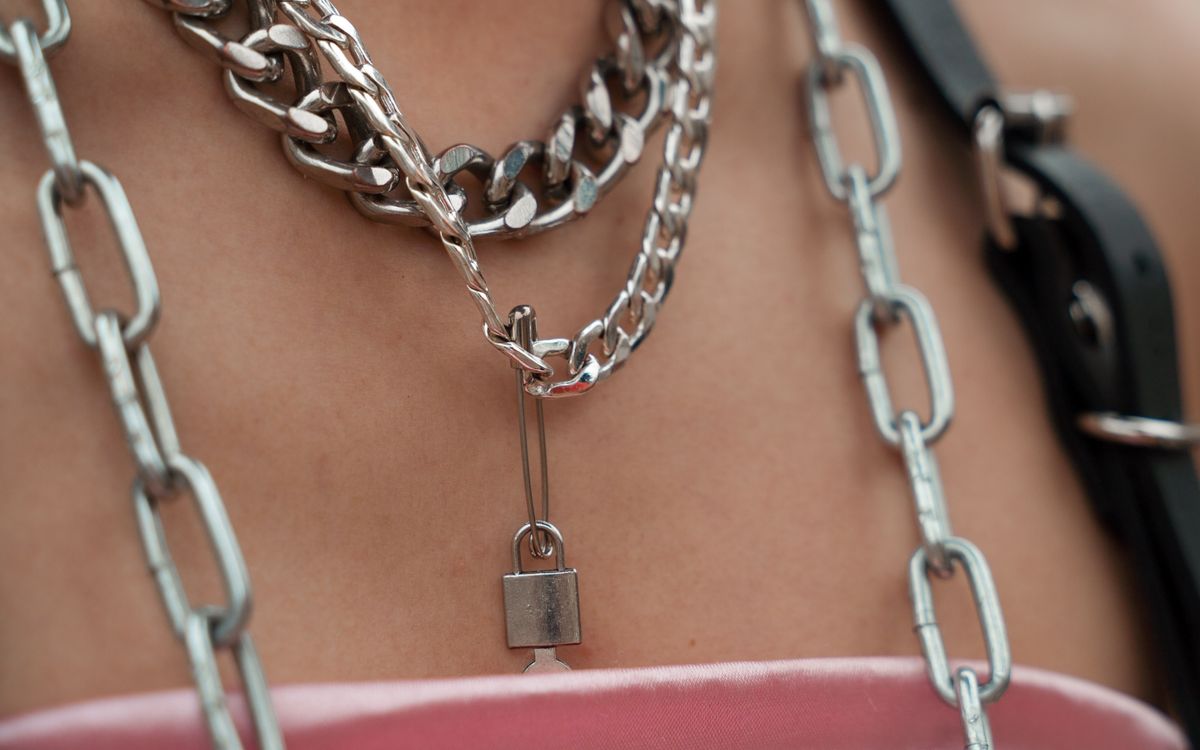
The chunky-versus-delicate question is usually framed as a taste debate, as if some people simply prefer heavy pieces and some prefer fine ones. In practice it is a composition problem, and composition has rules. Mixed scales work when the weights are organized — one register dominating, the other supporting — and fail when they are distributed evenly, because equal visual weight everywhere adds up to noise. The mechanics are worth spelling out, because once you see them, mixing a heavy cuff with thin bands stops being a risk and starts being a reliable system.
Scale is a load-bearing decision
Every piece of jewelry carries visual weight, and weight is read relative to context. A fine chain alone on a bare neckline reads as a deliberate line; the same chain next to a heavy signet gets demoted to background. This is the first rule of mixed scale: pieces do not have fixed weights — the heaviest piece in view sets the register, and everything else is measured against it. Which means the decision that matters is not “chunky or delicate” but “which piece is doing the heavy lifting today.” Answer that first, and the rest of the choices make themselves.
One statement per zone
The body reads jewelry in zones — neck, ears, wrists, hands — and each zone tolerates exactly one dominant weight. Inside a zone, the heavy piece leads and fine pieces support; across zones, you can distribute weight any way you like. The failures come from violating the per-zone rule: statement earrings and a statement necklace both want to be the feature near the same face, and the result is competition rather than composition. The combinations that reliably work are asymmetric: a chunky cuff with bare fingers, or a heavy pendant with a single fine band. When two heavy pieces do coexist — say a cuff and a signet — they work because they are far apart and share a metal or a visual mood, which makes the eye read them as one decision made twice rather than two competing decisions.
The 70/30 ratio
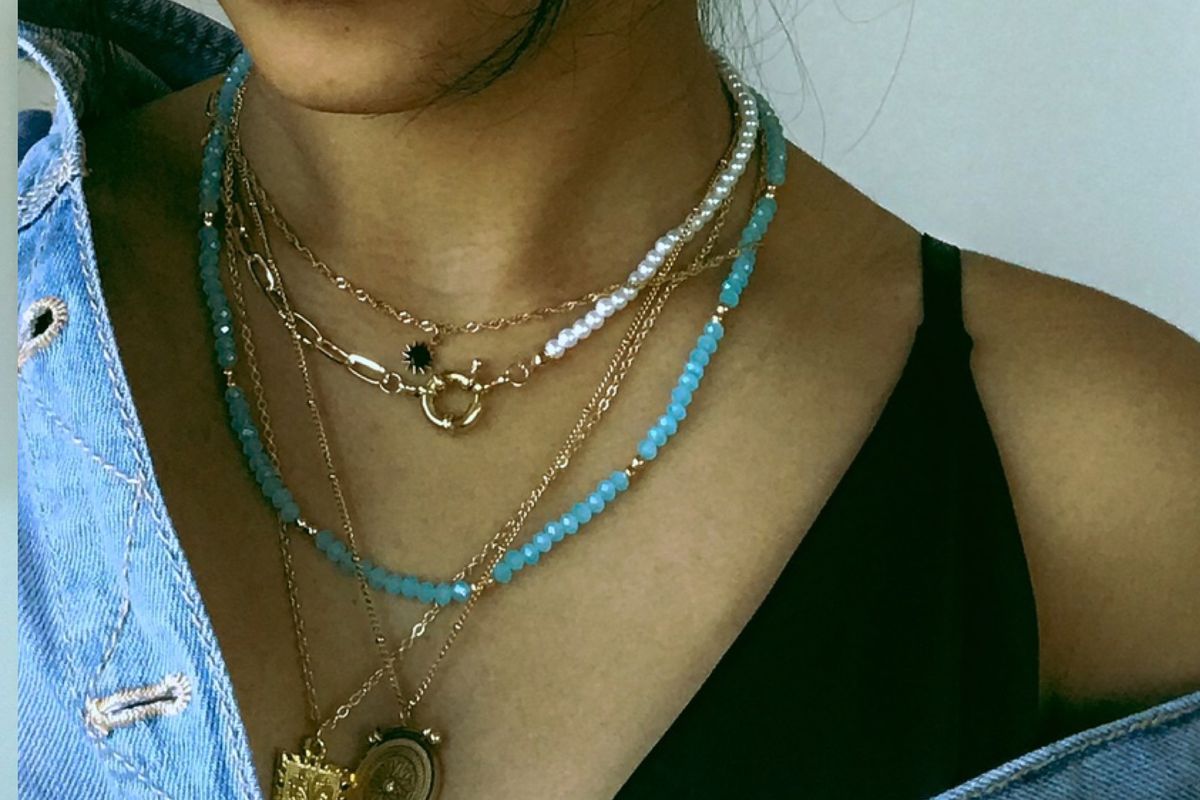
When mixing scales within a single zone — the stacked wrist is the usual laboratory — a useful default is roughly seventy percent one register, thirty percent the other. Three fine bangles under one cuff. A stack of thin rings with one substantial signet. The exact proportion is not a law; the principle is that one register must clearly lead. At fifty-fifty, the eye has no lead to follow and the stack reads unresolved, which is why the most common mixed-scale mistake is not wearing too much — it is wearing two regimes in exactly equal measure.
Ears are the exception
The ear zone breaks the one-statement rule because it has geometry the wrist does not: multiple piercing sites at different heights stack vertically, and vertical space tolerates more before it reads as clutter. The working pattern is a statement at the lobe and fine pieces climbing the ear, or the reverse — one heavy hoop at the lobe with two small studs above it carries the same logic as the 70/30 wrist.
Stacked hoops and the stud anchor
When stacking hoops upward, size decreases as you go up the ear, and the top position gets the smallest, lightest piece — the ear reads top-down as a taper. What keeps a multi-piece ear from looking chaotic is an anchor: one stud, plain, usually in the middle position, that gives the stack a still point. Without it, three moving hoops at three heights read as noise even when the sizes are well ordered.
Hands and wrists: the two-weight problem
Hands and wrists sit close together and get read as a single zone, which is why weight distribution across them matters more than either alone. The standard solves: weight on one wrist and fineness on the other; or weight on the hand — a heavy ring or two — with a deliberately quiet wrist. What reads badly is weight on both hands and both wrists simultaneously, which is the full-equal-distribution failure at its most visible.
What to do about rings that fight
Two chunky rings on adjacent fingers abrade each other and compete visually; the fix is spacing — heavy pieces separated by one bare or one fine-stacked finger. And a practical note that gets skipped: mixed-scale stacking has a physical dimension, because a heavy ring worn directly against a thin one scratches the thin one’s finish all day. Stack in the order you want the wear to happen, and give a plated piece, in particular, neighbors that will not chew its surface. Which constructions scratch which is mostly a hardness question, and the vermeil explainer covers the plating-specific version of that problem.
Necklines and the chunk-vs-fine interface
At the neck, scale interacts with the neckline the same way length does — the collar sets the frame and the pieces answer it. A chunky piece wants a clean neckline to sit against: crew necks, open collars, and square cuts give a heavy pendant or collar a horizon to work with. Fine chains near a heavy neckline disappear entirely, so under structured collars either go all-fine or all-heavy — mixed scale at the neck only works against a simple neckline. When layering gets involved, the weight rule folds into the length rule: shortest and lightest closest to the face, heaviest at the bottom, so the stack tapers downward. The full length mechanics are in the layering guide; weight follows the same ladder in the same direction.
When mixed scale reads as clutter
There is a reliable line between contrast and clutter, and it is worth being able to name it. Contrast has a lead — the eye lands on the heavy piece, then reads the fine pieces as deliberate support. Clutter has no lead: weights distributed evenly across every zone, every piece competing, nothing for the eye to resolve first. The test is a fast one. Look in the mirror at a normal distance for two seconds and note where your eye goes. If it lands somewhere specific, the composition works, whatever the mix. If it wanders, something needs to come off — and it is almost always a mid-weight piece, because middling pieces are what turn a clear two-register look into an unresolved crowd. For more on how weight, length, and count interact across a whole outfit, the styling desk collects the working versions of these rules.
Frequently asked
Can you mix chunky and delicate jewelry?
Yes, and the contrast is the point — but each visible zone gets one weight register that dominates. A heavy cuff with fine rings works; two heavy pieces in the same zone plus delicate fillers usually reads as clutter.
How many statement pieces can you wear at once?
One, occasionally two if they are on opposite sides of the body and share a metal or a mood. A statement necklace and statement earrings fight each other; a statement cuff with everything else fine rarely does.
Should delicate pieces go under or over chunky ones?
On the wrist, fine under heavy — delicate pieces peeking below a cuff read as layered, while a cuff over fine chains crushes and scratches them. On the neck, shortest and lightest closest to the face, heaviest at the bottom.